Best AI writing tools in 2026: The Complete Comparison Guide
Published: 2 Aug 2026
AI tools now touch almost every stage of content creation. Writers use them to get a draft of blogs. Editors use them to polish tone and grammar. Researchers use them to gather information in minutes instead of hours. Marketers use them to produce SEO focused content at scale.
This shift changes how content teams work. A single writer is now researching, drafting, editing, and optimizing an article in a fraction of the time it took two years ago. That speed brings real value, but it also brings confusion, because dozens of new tools launch every month and each one claims to be among the best AI writing tools in 2026 has to offer.
This guide organizes the entire AI Writing and Content Tools category into clear, practical sections. You will learn what each type of tool actually does and which tools are best suited for which tasks. How to build a complete content workflow using the right combination of AI tools rather than relying on a single platform for everything.
Table of Contents

AI writing tools use large language models to generate, edit, and optimize written content. Understanding this baseline helps you evaluate the best AI writing tools in 2026 with confidence.
They help with:
- Blog posts and long form articles
- Marketing copy and ads
- Social captions
- Emails and outreach content
Instead of starting from a blank page, you start from a working draft.
You need one if you:
- Publish content on a regular schedule
- Manage several client sites or projects
- Write your own marketing copy without a dedicated writer on staff
- Feel a constant time bottleneck around content production
Adoption has already moved past the experimental phase. HubSpot’s 2024 marketing report found that 71 % of marketers used generative AI tools in their daily work. That number shows how common these tools have become, and why choosing the right one matters more than ever.
The Main Categories of AI Writing Tools
The category splits into a few clear types. This is the fastest way to shortlist the best AI writing tools in 2026 for your workflow.
- General purpose AI models (ChatGPT, Claude, Gemini, Microsoft Copilot): It handle almost any writing format once you prompt them well.
- Marketing focused platforms (Jasper AI, Copy.ai): It built around brand voice, templates, and team collaboration.
- SEO integrated tools (Writesonic, Surfer SEO, Semrush SEO Writing Assistant): It combine drafting with keyword and structure guidance.
- Budget and workspace native tools (Rytr, Notion AI): It suit solo creators or teams already working inside one platform.
Know which category fits your task first. Compare individual tools only after that.
How We Compared the Best AI Writing Tools in 2026
We judged each tool against seven criteria that affect real writing work.
- Writing quality: how natural and usable the output feels with light editing
- SEO capability: this tool understands intent, keywords, and structure
- Ease of use: how fast a non technical person gets good results
- Pricing: real entry tier and mid tier costs, not a vague starting price
- Workflow integration: how well it fits your CMS, briefs, and editing tools
- Brand voice support: it keeps a consistent tone over time
- Limitations: what the tool struggles with, because every tool has gaps
No single tool wins every category. This blog focuses on matching. It not crowning one universal winner.
Best AI Writing Tools in 2026: Comparison Table
| Tool | Best For | Price (Entry Tier) | Key Benefit | Limitation |
| ChatGPT | Ideation, research, flexible writing | Free; Plus around $20/mo | Highly adaptable, strong research | No built in SEO tools or persistent brand voice |
| Jasper AI | Brand consistent marketing content at scale | From roughly $59 to $69/mo | Strong brand voice and team workflows | Costly for solo creators |
| Copy.ai | Fast, lightweight marketing copy | Free tier; paid plans vary | Guided workflows for non technical users | Limited SEO support |
| Writesonic | SEO integrated content creation | From roughly $39/mo | Drafting plus SEO and visibility tracking | Brand voice trails top tier writers |
| Claude | Long form, natural sounding prose | Free; Pro around $20/mo | Best writing quality among general models | No dedicated SEO layer |
| Gemini | Google ecosystem writing tasks | Free; paid tiers vary | Deep Google Workspace integration | Less specialized for content strategy |
Pricing changes often. Confirm current rates on each provider’s site before you subscribe.
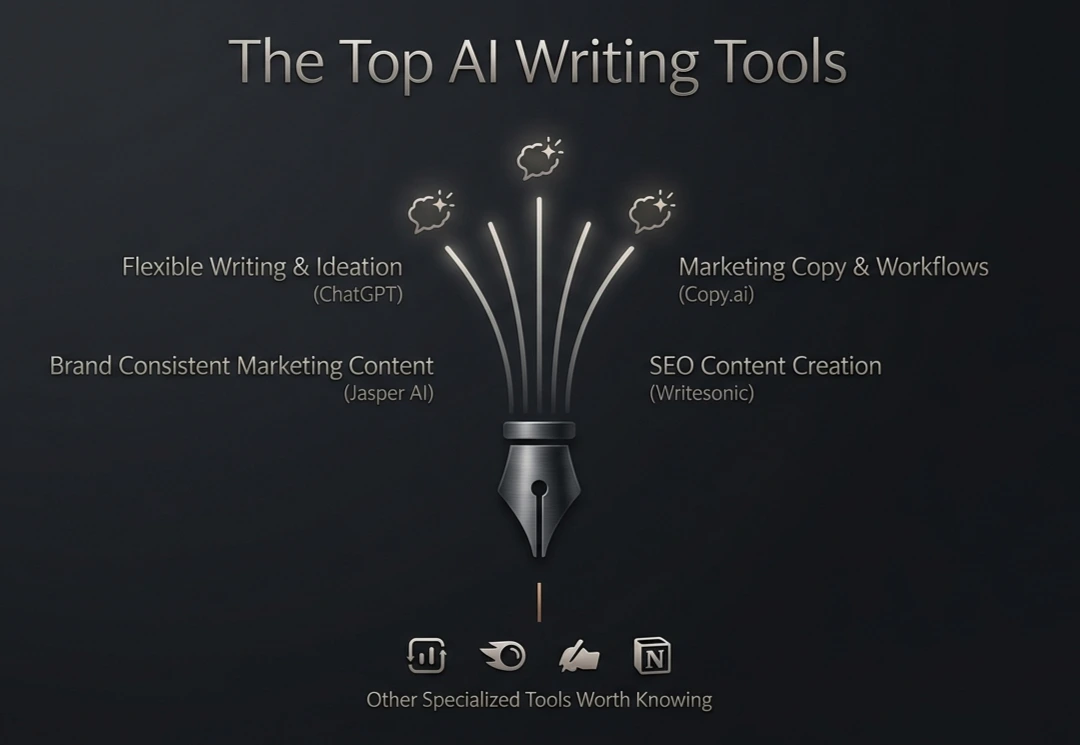
ChatGPT: Best for Flexible Writing and Ideation
ChatGPT earns this title because it adapts to almost any writing task once you provide clear, specific prompts and direction. ChatGPT works like a general assistant you shape into everything writers need. This flexibility is a big reason ChatGPT ranks among the best AI writing tools in 2026.
Strengths:
- Strong research and reasoning
- Fast ideation and outlining
- Drafts almost any format with clear direction
Weaknesses:
- No native SEO scoring
- No brand voice memory between separate chats
- No built in workflow for teams
It produces the most natural sounding long form prose among chat based models. That makes it a strong pick for essay style writing and thought leadership.
Gemini and Microsoft Copilot round out this group. Both work best inside their native ecosystems, Google Workspace and Microsoft 365.
Best for: solo creators, freelancers, and small teams willing to refine their prompts.
Jasper AI: Best for Brand Consistent Marketing Content
Jasper AI wins here because it learns your brand voice and applies it consistently across templates for every marketing campaign. Jasper serves teams that need volume without losing a consistent brand voice. That consistency is why Jasper stays on most lists of the best AI writing tools in 2026.
Strengths:
- Trained brand voice profiles
- Templates for ads, emails, and landing pages
- Collaboration features built for marketing teams
Weaknesses:
- Pricing sits well above ChatGPT or Copy.ai
- Long form or technical writing still needs a detailed brief and human review
Check the full Jasper AI pricing guide before you commit to an annual plan.
Best for: marketing teams and agencies producing high volumes of on brand content.
Copy.ai: Best for Marketing Copy and Workflows
Copy.ai wins this category because its guided workflows quickly turn simple prompts into ready short form marketing copy within minutes. Copy.ai leans into simplicity. It walks you through guided flows instead of an open prompt box. Copy.ai remains one of the best AI writing tools in 2026 for lightweight workflows.
Good for:
- Social captions
- Product descriptions
- Email copy
Limited for:
- SEO guidance
- Deep long form content
- Larger content operations with governance needs
Best for: lean marketing teams and small businesses that need steady short form copy.
Writesonic: Best for SEO Content Creation
Writesonic stands out for SEO content creation because it builds keyword, structure, and visibility guidance directly into every drafting session. Writesonic sits between a writing tool and an SEO platform. That blend keeps Writesonic among the best AI writing tools in 2026 for SEO-first teams.
What it offers:
- Keyword integration and internal linking suggestions
- Competitor informed structure
- A visibility layer that tracks how content performs in AI answer engines
Where it falls short:
- Writing quality and brand voice trail top tier writers
- Credit based pricing grows expensive at scale
Best for: SEO writers and small teams who want drafting and keyword optimization together.
Other Tools Worth Knowing
Surfer SEO analyzes top ranking pages and gives real time guidance on length, headings, and keyword usage. Most teams pair it with a general model instead of using it alone.
Semrush SEO Writing Assistant works the same way, and suits teams already inside the Semrush ecosystem.
Rytr costs only a few dollars a month. It handles short form drafts and basic outlines well, but struggles with deep long form work.
Notion AI makes sense only if your team already manages content inside Notion, since its features live entirely within that workspace.
Which AI Writing Tool Fits Your Role?
Most guides stop at features. The better question asks which tool matches your actual job.
| Role | Recommended Tool | Why |
| Bloggers | ChatGPT or Claude | Flexible tone, strong long form drafting, low cost to start |
| SEO writers | Writesonic or Surfer SEO + a drafting tool | Built in keyword and structure guidance |
| Freelancers | ChatGPT | Lowest cost, adaptable across client niches |
| Small business owners | Copy.ai or Rytr | Simple, affordable, easy to learn |
| Marketing agencies | Jasper AI | Brand voice consistency across multiple clients |
If you fall between two roles, start with the cheaper and more flexible option. Add a specialized tool once your volume justifies the cost.
Does Google Penalize AI Generated Content?
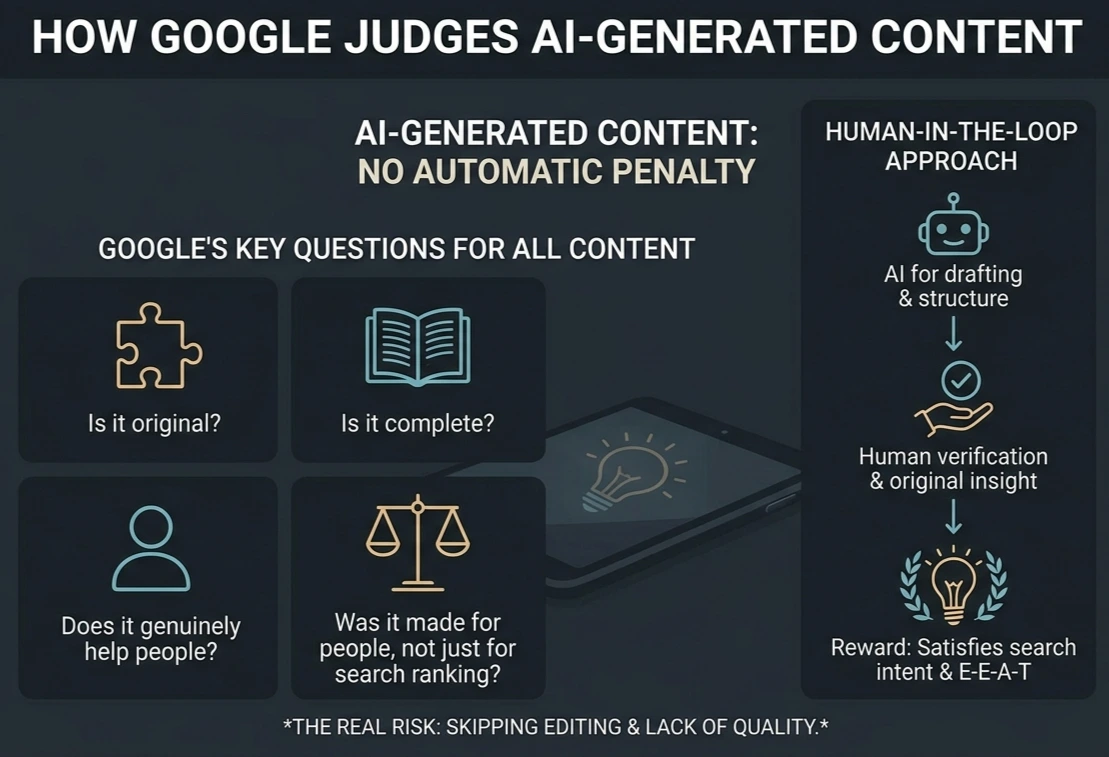
No, not simply because AI produced it. Google’s guidance on helpful, people first content focuses on how content serves the reader, not how someone created it.
The key questions Google asks:
- Does the content stay original?
- Does it fully answer the topic?
- Did someone create it to genuinely help the reader, not just to rank?
AI assisted content follows the same rules as human written content. It needs to satisfy search intent to avoid generic filler, and reflect real expertise where it matters.
A human in the loop approach works best. AI handles drafting and structure, while a person verifies accuracy and adds original insight. The real risk comes from skipping the editing step, not from using the tool itself. That is true no matter, you use a free tool or one of the best AI writing tools in 2026.
| How to Build an AI Content Workflow |
|---|
|
Most people rely on a single tool for everything, then wonder about why the result feels generic. A stronger approach treats AI writing as five stages:
Voice based workflows are also growing in 2026. Creators dictate ideas instead of typing prompts, and the tool structures the spoken input into a draft. Why this works better than one tool for everything:Each stage rewards a different kind of tool. Research tools earn their value through breadth. Drafting tools earn it through speed. Editing tools earn it through precision. Optimization tools earn it through real search data. On a tight budget, even a free version of this stack works: a free general model for research and drafting, a free grammar checker for editing, and a few hours learning one SEO tool’s free features. |
Common Mistakes of Using AI Writing Tools
Even the best AI writing tools in 2026 can’t fix these habits for you.
- Publishing the first draft. AI output almost always needs a human pass for accuracy, voice, and originality.
- Relying on one tool for everything. A general model, a brand voice tool, and an SEO tool solve different problems.
- Vague prompting. Specific prompts about audience, tone, length, and key points produce far better drafts.
- Ignoring data and privacy policies. Free tiers on some platforms use submitted content to help train models.
- Skipping fact checking. AI models sometimes produce confident sounding claims that turn out to be wrong.
- Trusting AI detection tools as proof. These detectors often flag human writing as artificial and miss AI writing entirely.
- Trusting old pricing information. Every tool updates pricing often. Confirm current rates before you commit to a plan.
Beginners generally start well with ChatGPT’s free tier, since it stays flexible and forgives imperfect prompts. Professionals managing volume or brand consistency tend to move toward Jasper or a paired drafting and SEO stack.
Free tiers work well for brainstorming, outlining, and casual drafting. Paying makes sense once you need brand voice consistency, higher usage limits, or built in SEO guidance.
ChatGPT gives you a general purpose model you configure yourself. Dedicated platforms like Jasper or Copy.ai, also among the best AI writing tools in 2026, wrap that same technology in templates, brand voice settings, and team workflows.
Costs range from free (ChatGPT, Claude, and Gemini free tiers) to roughly $39 to $70 per month for dedicated platforms like Writesonic and Jasper. Check current pricing directly with each provider.
No. Even the best AI writing tools in 2026 speed up drafting, research, and structure, but strategy, subject expertise, fact checking, and final editorial judgment still need a human.
Conclusions
AI tools update their features, pricing, and limitations often, sometimes within weeks of a new release. Every tool listed here has real limitations, including occasional factual errors, generic output when prompts are vague, and pricing that can change without notice. This overview of the best AI writing tools in 2026 will keep evolving as tools change.
Evaluate any tool against your current needs, and confirm pricing directly on the provider’s site before you commit to a paid plan. Come back often, since the list of the best AI writing tools in 2026 will keep shifting.









- Be Respectful
- Stay Relevant
- Stay Positive
- True Feedback
- Encourage Discussion
- Avoid Spamming
- No Fake News
- Don't Copy-Paste
- No Personal Attacks
- Be Respectful
- Stay Relevant
- Stay Positive
- True Feedback
- Encourage Discussion
- Avoid Spamming
- No Fake News
- Don't Copy-Paste
- No Personal Attacks
