Why Do Researchers Use Genei AI to Save Time In 2026
Published: 30 Mar 2026
Research work has a hidden problem. The problem is not a lack of information. It is too much of it. A typical researcher deals with dozens of PDFs with scattered notes. His browser tabs never close, and a growing fear of missing something important buried in a document they half-read three days ago.

Genei AI was built to solve the same problem.
The platform launched in 2021. It came out of Y-Combinator and won Oxford University’s AllInnovate competition. It earned a spot on TechCrunch’s list of favourite startups of the same year. Those credentials matter very much but the main reason for Genei growing was simpler than press coverage. It genuinely works.
This review covers everything. What does Genei do? How does it compare to ChatGPT, Elicit, and Scholarcy? Who benefits most from it? What does it cost? And several important angles that most other reviews have never addressed.
Table of Contents
| What Is Genei AI? |
|---|
|
Genei is an AI tool of research and summarisation. It uses natural language processing to build on GPT-3 and BERT. It extracts key insights from uploaded PDFs and webpages. We bring our documents and Genie reads it to summarize them. It identifies keywords, answers the research questions, and links every finding back to its original source in the document. No information floats without a citation attached to it. Genei is not a writing assistant and not a search engine. It sits in the space between “a pile of sources” and “something useful to work with”. It functions like a dedicated research analyst embedded inside a personal document library. |
Who Is Genei AI For?
Genei AI marketing ways are focused heavily on students and academics. It is a reasonable starting point, but it leaves out a large portion of the people who easily benefit from the tool every day.
Students and academic researchers. They get the most immediate and obvious value. Summarising 20 journal papers before a literature review deadline is exactly the kind of task Genei handles fastest.
PhD candidates: These students rely heavily on the cross-document question-answering feature. PhD students ask Genei directly, and the tool searches across the entire uploaded library rather than re-reading every paper to locate one specific methodology or statistic.
Content writers and SEO professionals: They use Genei AI and AI Content Creators to move through industry reports of white papers, and competitor research at a far higher speed. Ten documents uploaded to a single project allow a content professional to surface recurring themes, identify angles. It builds a content brief in minutes rather than hours.
Market analysts and business intelligence professionals: They process earnings releases of sector reports, and policy documents through Genei AI the same way. The keyword extraction and cross-document search functions work just as effectively in corporate settings as in academic ones.
Legal professionals: They use Genei AI for broad-level document review. It spot recurring clauses for cross-referencing arguments, and mapping positions across multiple case files. Genei is not a purpose-built legal AI, but the general research capability transfers well into legal contexts.

AI Summarisation
You have to upload a PDF, even a thick, 50-page scholarly article. Genei AI generates a structured summary divided into clear sections. It connects every summary point with the exact passage in the original document. A reader can just give a single click and be redirected to the source to obtain a more comprehensive insight or confirmation.
The accuracy is always high with standard academic and professional papers. We easily access vital concepts of a long paper within about five minutes. Larger documents (more than 100 pages) often produce less consistent results. You process long texts more effectively by breaking them into smaller parts.
Cross-Document Question Answering
Genei AI searches the entire library when we type a simple question in plain English across stored documents. It generates a synthesised response using relevant sources and provides clear references.
Genei delivers this feature effectively for anyone who previously cross-referenced multiple papers to create a literature review. When you do this task it took an entire afternoon and now takes only about twenty minutes.
Smart Note-Taking and Source Linking
Genei AI provides an inbuilt notepad. It stores highlights, summary points, and AI-generated notes. It links every note directly to its exact position in the original document. Genei AI ensures the users never lose the source. It completely removes the frustration of searching for a half-remembered quote.
Keyword Extraction and Citation Management
As the research advances Genei automatically presents the best keywords in every document and ranks them. Genei AI builds the reference list naturally during the workflow. The users complete most of the bibliography during active research instead of leaving it for the end.
Chrome Extension
The Genei Chrome extension allows us to add web articles and pages directly to a project during browsing. It eliminates the need for manual downloading or file uploading. We capture a webpage with a single click and instantly view it inside Genei for analysis.
We quickly set it up by downloading it from the Chrome Web Store. Logging into their Genei account, and using the add-to-Genei button available on every webpage. Genei makes newly added pages searchable and summarizable alongside uploaded PDFs within the same project.
Microsoft SharePoint Integration
Many reviews overlook this integration, but Genei includes it as a key feature. Genei AI directly integrates as an add-on within Microsoft SharePoint. This integration makes Genei a strong choice for enterprise environments where teams already manage documents within the same ecosystem. Genei also integrates with Google Drive, Dropbox, OneDrive, Box, and Evernote.
How Does Genei Work The Technology Behind It?
Genei runs on a combination of large language models and a technique called Retrieval-Augmented Generation. It is commonly shortened to RAG. It understands the RAG briefly and makes the tool’s behaviour far easier to understand.
Most general-purpose of all AI tools, including ChatGPT, are to operate from a fixed body of training data. They generate answers based on what they were trained on. The core limitation is that they cannot read a user’s own specific documents. When they are pressed for precise details, they sometimes produce confident-sounding answers. Such answers have no real grounding. This problem is known as hallucination.What Core Features Does Genei Actually Offer?
RAG works differently. Instead of relying solely on pre-trained knowledge, the system checks the actual passages from uploaded documents and uses these passages to form its responses. Every answer Genei AI produces is grounded directly in the source material. Every response carries a citation. The risk of a fabricated or made-up fact is meaningfully lower than in pure generative AI tools.
This is the core reason Genei behaves so differently from ChatGPT in a document-heavy research setting. ChatGPT draws from the open internet or its training data. Genei draws from the document library a user has built.

| Is Genei AI Useful for Non-Academic Users? |
|---|
|
Every major Genei review published to date focuses almost entirely on students and academics. That leaves a significant gap in the picture. A content strategist’s day-to-day work involves reading industry reports, competitor content, research studies, and white papers. All to find angles worth writing about. Genei compresses that research phase substantially. Ten industry reports in a single project with one question typed. The recurring themes surface in minutes, not in just hours. The output becomes a content brief, ready to act on. Market analysts processing quarterly earnings releases, sector reports, and policy documents get the same acceleration. The NLP-powered analysis applies equally whether the documents came from a university database or a financial research platform. Legal professionals reviewing contracts or case documents find the cross-referencing capability useful for pattern recognition. It spots recurring the clauses and mapping positions across multiple files. Genei is not a dedicated legal research tool, but its core document intelligence functions well in that context. |
How Does Genei Compare vs the Alternatives?
Genei vs ChatGPT
| Feature | Genei | ChatGPT (GPT-4) |
| Works on uploaded documents | Yes — core function | Limited; uploads reset per session |
| Cross-document search | Yes | No |
| Source-linked answers | Yes, always cited | No |
| Creative writing and brainstorming | Limited | Excellent |
| Hallucination risk | Lower (RAG-grounded) | Higher on specific facts |
| Best for | Deep document research | General tasks, brainstorming |
| Verdict | Better for document-heavy research | Better for open-ended thinking |
These two tools are not real competitors. They serve different moments in the same workflow. Genei handles the research and synthesis phase. ChatGPT handles the generation and exploration phase.
If your focus is writing instead of research, tools like Wordtune Login and Grammarly Premium are more suitable alternatives.
Genei vs Elicit
Elicit is built for scientific literature discovery. It searches external databases like Semantic Scholar and helps researchers find papers they have not yet read. Genei works with documents users have already gathered.
| Feature | Genei | Elicit |
| Searches external databases | No | Yes (Semantic Scholar) |
| Works with uploaded documents | Yes | Limited |
| Multi-document Q&A | Yes | Partial |
| Citation management | Yes | Yes |
| Best for | Synthesising existing sources | Discovering new literature |
| Verdict | Better for working through sources already found | Better for finding sources not yet found |
Many researchers use both tools at different stages. Elicit is used to discover, Genei AI is uesd to synthesise.
Genei vs Scholarcy
Scholarcy breaks individual research papers into fast structured summaries of their abstract, key findings, limitations, and references. It excels at triage where we have to decide quickly which papers warrant deeper reading. Genei does this too, but adds cross-document intelligence that Scholarcy does not offer.
| Feature | Genei | Scholarcy |
| Single-paper summarisation | Yes | Yes — very fast |
| Cross-document synthesis | Yes | No |
| Source-linked notes | Yes | Limited |
| Best for | Analysing a collection of sources | Fast triage of individual papers |
| Verdict | Better for multi-source research projects | Better for rapid single-paper screening |

What Does Genei AI Pricing Actually Cost?
Genei operates on a subscription model. Every plan comes with a full 14-day free trial complete feature access It has no payment required to begin.
| Plan | Monthly Price | Annual Price (Est.) | Best For |
| Basic — Professional | £9.99/mo | ~£7.99/mo | Professionals needing document management and AI summaries |
| Pro — Professional | £29.99/mo | ~£23.99/mo | Power users needing cross-document Q&A and multi-doc analysis |
| Basic — Academic | £4.99/mo | ~£3.99/mo | Students needing core research tools at a lower price |
| Pro — Academic | £19.99/mo | ~£15.99/mo | PhD students and researchers wanting full feature access |
Academic plans cost roughly half of the professional rate. Verification of academic status is typically a university email address and it unlocks the discount immediately.
Annual billing reduces the monthly equivalent cost further. Someone who completes the trial and decides Genei AI fits with their workflow. The annual option is worth comparing before choosing a plan.
The 14-day free trial is full-featured. It is not a limited preview. Every feature across the Pro tier is accessible during those 14 days.
This section is absent from almost every Genei AI review available. It is a significant gap particularly for professional and enterprise users.
Genei processes uploaded documents on its own servers to generate summaries and power the search and question-answering features. The appropriate framing is to treat Genei the same as any other cloud-based document platform. This presents no real concern for most research and professional use cases.
Where caution is warranted: classified materials, documents are covered by strict non-disclosure agreements, and data governed by sector-specific regulation. Healthcare records, financial client data, and similar categories are also mentioned in it. In those cases, Genei’s privacy policy at genei.io warrants careful review before uploading.
For the vast majority of academic, content, and business research workflows, data handling is not a practical limitation.
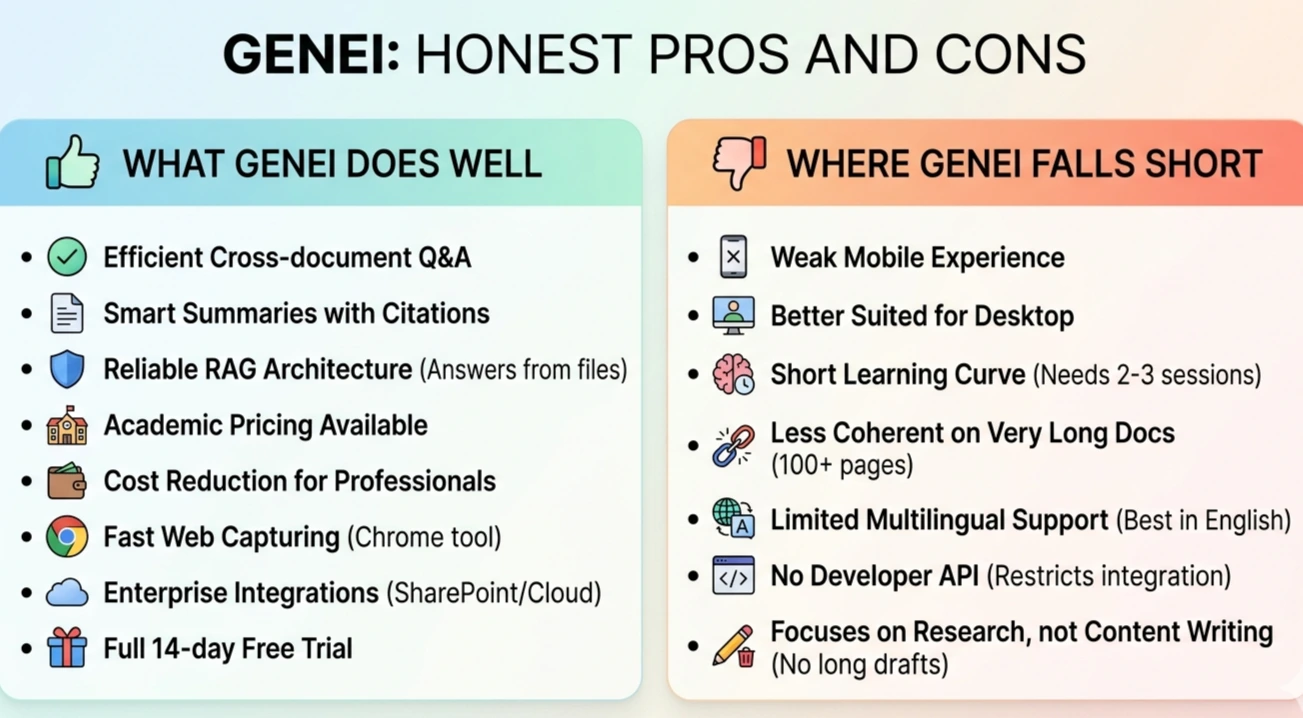
What Are the Honest Pros and Cons of Genei?
- Cross-document Q&A generates really useful results and saves actual research time.
- Summaries that have source links prevent the citation-tracking issue.
- RAG architecture retains all the answers based on real uploaded documents.
- Genei offers academic pricing options for users.
- It reduces costs by approximately fifty percent for professionals with limited budgets.
- The Chrome tool allows one to quickly capture web sources and no files have to be handled manually.
- Genei is feasible in the enterprise through share point and cloud storage integration.
- Genei provides a full-featured 14-day trial instead of a limited version.
- Genei AI delivers a weaker experience on mobile devices.
- The platform is primarily designed for desktop use.
- The interface requires a short learning period for new users.
- Most users need two or three sessions to become fully comfortable.
- Genei produces less coherent results when processing documents longer than 100 pages.
- Its NLP capabilities perform best in English, while multilingual support remains limited.
- Genei does not offer a developer API.
- This limitation restricts custom integration opportunities.
- Genei focuses on research rather than content writing.
- It does not generate long-form drafts.
How to Get Started with Genei AI Step by Step?
When we begin with Genei it is easy. The entire installation is within ten minutes. We explain each step clearly below. You do not need any technical background to get started.
Step 1: Sign Up at Genei.io
(Under 2 minutes)
Go to genei.io and sign up to a free account. The 14 days trial begins immediately and offers the access to all features. At this point, there is no requirement of any credit card or payment information. A password and an email address are all one needs and the account is instantly ready to use.
Step 2: Create a Project
(1 minute)
Start by creating a project after logging in and name it based on your research topic or content focus, such as Climate Change Studies or Market Research Q3. Genei organizes all documents and notes in one well-structured place. This structure helps users quickly find everything later without browsing multiple folders.
Step 3: Upload Source Documents
(2–5 minutes depending on volume)
You can upload PDFs directly using drag-and-drop from your computer. The Genei Chrome extension captures web pages with a single click and automatically adds them to your project while browsing. This process removes the need for manual downloading or file renaming. Both methods work seamlessly within the same project without requiring extra steps or technical setup.
Step 4: Review AI Summaries
(5–10 minutes per document)
Genei generates a structured summary immediately after you upload a document. It breaks the document into key sections with clear bullet points. It links each summary point directly to its exact location in the original file. These summaries help users quickly identify the most relevant information. This approach saves hours compared to reading entire documents manually.
Step 5: Ask Cross-Document Questions
(2–3 minutes per question)
This is where Genei AI separates itself from basic summarisation tools. Type a plain-English question something like “What methods appear most often across these studies?”. Genei AI searches every uploaded document at once. The answer arrives in seconds also with citations from each relevant source clearly listed. Researchers who previously spent hours cross-referencing papers now complete this in minutes.
Step 6: Save Insights to the Notepad
(Ongoing)
Genei stands out from basic summarisation tools in this step. We ask simple questions like What methods appear most frequently in these studies. Genei AI scans all the uploaded documents simultaneously. It delivers responses within seconds along with clearly cited sources. Researchers can now complete tasks that once took hours in just a few minutes.
Step 7: Export Notes and Citation List
(Under 2 minutes)
When the research phase is complete, notes and the full citation list export with one click. The exported file is ready to paste into a report, essay, or article draft. The reference list builds itself throughout the research process. There is no last-minute scramble to track down sources before submission or publication.
No direct native integration with Zotero or Mendeley currently exists. A practical two-stage workflow: use Zotero or Mendeley to discover and store citations during the literature search phase, then import the shortlisted PDFs into Genei for deep analysis and cross-document synthesis during the research phase.
The RAG architecture reduces hallucination risk meaningfully compared to purely generative AI tools, because every response is built from specific passages in uploaded documents rather than from generalised training data. No AI system is infallible. Key statistics, direct quotes, and specific claims warrant verification against the source before publication or formal submission.
For working through a specific set of uploaded documents. Genei AI outperforms ChatGPT clearly. Every answer Genei produces links back to a source inside the uploaded library. ChatGPT draws from its training data or the open web and does not maintain that kind of source linkage. The two tools complement each other well Genei for research, ChatGPT for generation.
Conclusion
Genei AI is not a replacement for analytical thinking. It removes the parts of research that do not require analytical thinking. The skimming, the tab management, the frantic search for a half-remembered quote from three days ago.
Its value is immediate for students and academics. Market analysts, and knowledge workers who regularly process large volumes of documents for content professionals. The benefit is equally real and far less discussed in existing reviews.
The 14-day full-access trial is long enough to run an actual project through the tool. It is for anyone whose work regularly involves documents and who spends more time. It manages sources rather than thinking about what those sources actually mean the trial is worth starting.






- Be Respectful
- Stay Relevant
- Stay Positive
- True Feedback
- Encourage Discussion
- Avoid Spamming
- No Fake News
- Don't Copy-Paste
- No Personal Attacks
- Be Respectful
- Stay Relevant
- Stay Positive
- True Feedback
- Encourage Discussion
- Avoid Spamming
- No Fake News
- Don't Copy-Paste
- No Personal Attacks
